
By Mark Gruber, Founder of OpEdge Advisory LLC
Growth changes an organization.
What worked when the company was smaller, more centralized, and easier to manage often becomes less effective as the business expands. More employees, more customers, more complexity, and more competing priorities place entirely different demands on leadership.
That is why high-growth companies do not simply need more leaders. They need better leadership systems.
Growth Exposes the Limits of Informal Leadership
In the early stages of a company, leadership is often highly personal. The founder or senior team stays close to major decisions. Communication happens quickly. Priorities are understood because everyone is relatively connected to the same conversations.
That model can work extremely well. Until it doesn’t.
As the organization grows, informal communication starts to break down. Decisions take longer. Teams interpret priorities differently. Senior leaders become involved in issues that should be handled elsewhere. Employees may be working hard, but not always in the same direction.
These are not necessarily people problems. They can be signs that the leadership system has not evolved at the same pace as the business.
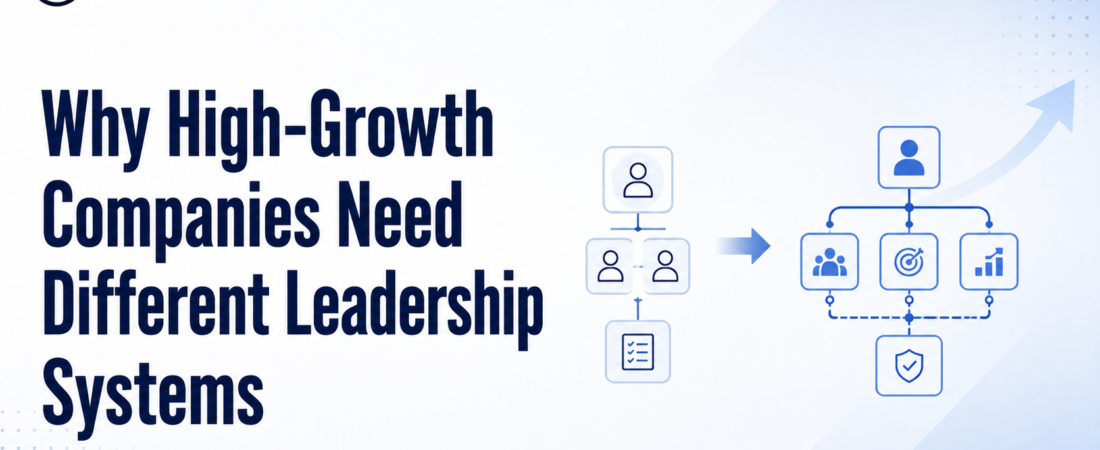
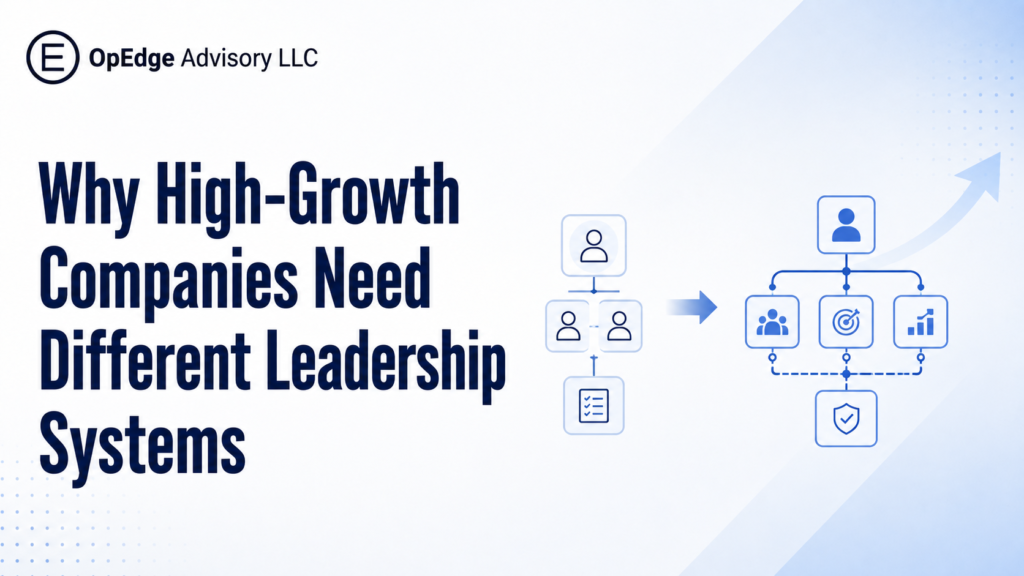
The leadership model that helps build a company is not always the leadership model that can scale it. Growth requires leaders to become more deliberate about how decisions are made, how accountability works, and how the organization stays aligned.
Leadership Must Become More Intentional
As complexity increases, leaders can no longer rely primarily on proximity, instinct, or frequent involvement in day-to-day decisions. The organization needs clearer structures.
That means defining who owns what, where decisions should be made, how information moves through the organization, and how leaders remain aligned on the priorities that matter most.
Without that clarity, growth can create unintended friction. Senior executives become bottlenecks. Teams duplicate effort. Decisions get pushed upward unnecessarily. Employees spend more time navigating the organization and less time executing.
Delegation Is Not the Same as Leadership Scale
Some executives recognize that they need to delegate as the company grows. However, simply handing off more responsibilities is not enough.
Effective delegation requires clear expectations, decision rights, accountability, and visibility into performance. Otherwise, leaders can find themselves taking responsibility back when something goes wrong.
That creates a cycle in which executives attempt to delegate, become uncomfortable with the results, and return to being heavily involved in execution.
The better approach is to build a system where leaders know what they own, understand the boundaries of their authority, and are accountable for measurable outcomes. That is how organizations reduce dependence on a small number of senior people.
The Role of the Executive Team Changes Too
Growth also changes what the senior leadership team should spend its time doing. Executives who helped build the business may be accustomed to solving immediate operational problems.
As the company scales, their highest-value contribution increasingly shifts toward setting direction, allocating resources, developing leadership talent, strengthening the operating model, and preparing the organization for what comes next. That transition is not always easy.
Leaders are sometimes rewarded early in their careers for being great problem solvers. At scale, however, the goal should not be to solve every problem personally. It should be to build an organization capable of solving problems effectively without constant executive intervention.
Strong Leadership Systems Create Alignment Without Creating Bureaucracy
There is a common concern that adding structure will slow a growing organization down. Poorly designed structure certainly can.
The absence of structure creates its own form of bureaucracy: repeated meetings, unclear ownership, unnecessary approvals, duplicated work, and constant escalation.
The objective is not to introduce layers for the sake of control. It is to create enough clarity that people can move faster.
The best leadership systems establish clear priorities, decision rights, accountability, communication rhythms, and performance expectations while preserving the flexibility that made the organization successful in the first place.
Growth Requires Leadership to Evolve Before the Organization Forces It To
Companies sometimes wait until growth creates visible problems before revisiting how leadership operates. By then, the symptoms may already be familiar: slower decision-making, inconsistent execution, overloaded executives, unclear priorities, and increasing frustration across teams.
The stronger approach is to anticipate the transition. Executives should regularly ask whether the leadership systems that worked at the current stage will still work at the next one.
Growth is not simply about increasing revenue, headcount, or market share. It is about increasing the organization’s capacity to operate effectively at a larger scale. That requires leadership systems designed for where the company is going, not just where it has been.
If your organization is preparing for its next stage of growth, the question may not be whether you have enough leadership. It may be whether your leadership system is ready to scale.