
By Mark Gruber, Founder of OpEdge Advisory LLC
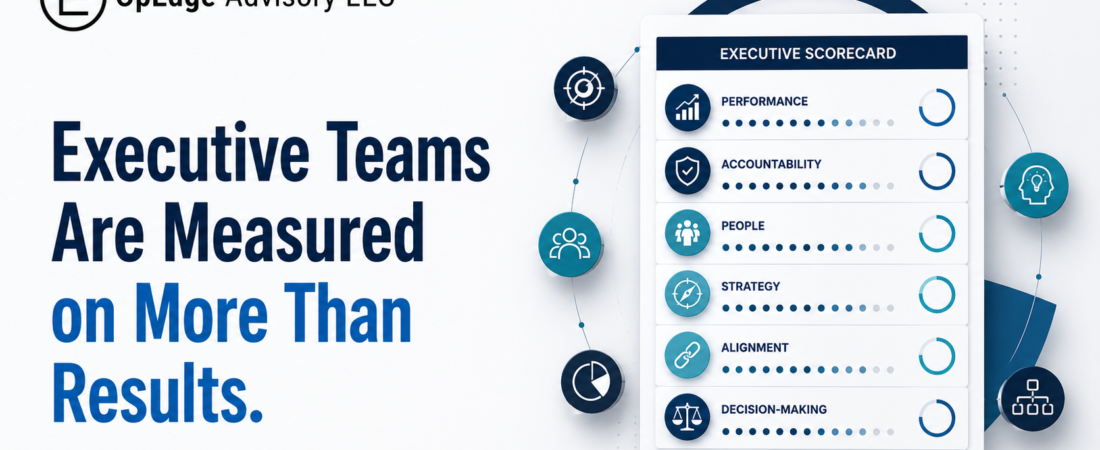
Results often judge executive teams. Revenue growth. Margin performance. Market share. Execution against plan.
Those metrics matter, but they are only part of the picture. Investors, boards, and CEOs are also evaluating something less visible but equally important: whether the executive team has the leadership capability to guide the organization through complexity, uncertainty, and growth.
Strong performance in a stable environment is one thing. Leading effectively when the organization is expanding, priorities are shifting, or the market is changing is something else entirely. That is when the quality of an executive team becomes much easier to see.
Results Matter, But So Does How They Are Achieved
A leadership team can sometimes deliver strong short-term results while creating longer-term problems. Decisions may be centralized around one or two executives. Functions may operate independently rather than collaboratively. Important issues may be delayed because no one wants to challenge the prevailing view. The organization may hit its numbers, but the underlying leadership model may not be sustainable.
Boards and investors increasingly look beyond the immediate outcome. They want to understand whether the team is building an organization capable of sustained performance.
That means asking questions such as:
- Does the executive team make sound decisions consistently?
- Do leaders understand how their functions affect the broader organization?
- Is accountability clear?
- Can the team address difficult issues directly?
- Are leaders building capability beneath them?
- Is the organization becoming stronger as it grows?
These questions can provide a better indication of long-term leadership effectiveness than any single quarter.
Alignment Is More Valuable Than Agreement
Strong executive teams do not agree on everything. In fact, they shouldn’t. Different perspectives improve decision-making when leaders are willing to challenge assumptions, debate priorities, and surface risks. The important thing is what happens after the debate.
Once a decision is made, the executive team must be able to align around it and move forward together. Boards and CEOs notice when leaders continue advocating for their individual functions instead of supporting the broader enterprise. They also notice when decisions repeatedly have to be revisited because alignment was never really achieved.
Healthy executive teams can disagree without becoming dysfunctional. They challenge each other when necessary, make decisions, and then execute as one leadership team. That ability becomes especially important as organizations grow and the consequences of misalignment become larger.
Strong Leaders Think Beyond Their Functions
Every executive is responsible for a specific area of the business. The CFO has financial responsibilities. The CHRO has people responsibilities. The COO has operating responsibilities. Commercial leaders have growth responsibilities.
Effective executive leadership requires more than functional expertise, however. The strongest leaders understand that once they join the executive team, they also become responsible for the performance of the enterprise. That means being willing to engage in decisions outside their immediate area. It means understanding tradeoffs. It means balancing functional priorities against what is best for the organization overall.
Executives who operate primarily as advocates for their departments can create silos at the level where the organization most needs alignment. Investors, boards, and CEOs tend to value leaders who can move comfortably between functional depth and enterprise-level thinking.
The Ability to Lead Through Uncertainty Matters
Growth rarely happens in a straight line. Markets shift. Competitors respond. Customer expectations change. New opportunities emerge. Some investments work, and others do not.
Executive teams cannot wait for perfect information before making decisions. They need to be able to evaluate what they know, acknowledge what they do not know, and make thoughtful decisions anyway. That requires judgment. It also requires the confidence to adjust when circumstances change.
Good leadership is not about pretending uncertainty does not exist. It is about creating enough clarity for the organization to keep moving despite it. Boards and CEOs look for leadership teams that can remain focused without becoming rigid. They want executives who can distinguish between a temporary disruption and a meaningful change in direction.
They want leaders who can communicate clearly enough that the rest of the organization understands what matters, even when the environment is changing.
Accountability Builds Confidence
One of the quickest ways for an executive team to lose credibility is to avoid accountability.
When results fall short, strong leaders do not spend their energy explaining why another department, the market, or an external event was responsible. They acknowledge the outcome, understand what happened, and determine what needs to change.
That does not mean every problem belongs to one person. Many significant business challenges cross functional lines, but collective responsibility should not become an excuse for unclear ownership. Strong executive teams know who is responsible for what. They hold one another accountable, and they address performance issues before they become larger organizational problems.
That kind of accountability builds confidence because it demonstrates that the leadership team can identify issues and act on them.
Executive Teams Must Build Leadership Capacity
An executive team should not simply run the business that exists today. It should also be building the leadership capability required for what comes next.
As organizations grow, the demands on senior leadership increase. Executives who remain involved in too many operational decisions eventually become bottlenecks. Strong leaders recognize this and develop capable leaders beneath them.
- They delegate meaningful responsibility.
- They create clear decision authority.
- They coach and develop talent.
They build teams that can operate effectively without constant executive intervention. From a board or investor perspective, this matters because leadership depth reduces organizational risk. A company that depends heavily on a handful of individuals is more vulnerable than one with strong leadership capability throughout the organization.
The Executive Team Sets the Operating Standard
Organizations pay close attention to what senior leaders do. If executives avoid difficult conversations, the rest of the organization often will too. If leaders tolerate unclear accountability, that behavior spreads. If senior leaders compete with one another instead of collaborating, silos become stronger. The opposite is also true.
When the executive team communicates clearly, resolves issues directly, and demonstrates shared accountability, those behaviors influence the broader organization. Leadership systems are shaped not only by structure and process, but also by example. That is why the effectiveness of an executive team has such a significant impact on organizational performance.
Growth Raises the Standard
Growth increases complexity. More people. More customers. More decisions. More competing priorities. As that complexity increases, weaknesses within the executive team become harder to hide. Communication gaps become more expensive. Slow decisions create larger consequences. Misalignment spreads further through the organization, and excessive dependence on individual executives becomes increasingly difficult to sustain.
The leadership team that helped an organization reach one stage of growth must be capable of leading it into the next, but that does not necessarily mean changing the people. It might mean changing how those people lead together.
The Real Measure of an Executive Team
Investors, boards, and CEOs will always care about performance. They SHOULD, but the strongest executive teams create confidence that performance can continue.
They demonstrate sound judgment. They operate with accountability. They challenge one another constructively. They think beyond their individual functions. They develop leadership capacity throughout the organization, and they help create an operating environment capable of adapting as the business grows.
Quarterly results tell you what happened, but the quality of the executive team helps determine what the organization is capable of doing next.